Convolution reverbs are not all created equal. In this article we tell you why LiquidSonics’ Fusion-IR is special.
Why Fusion-IR is different from other convolution reverb technologies
Fusion-IR
LiquidSonics’ revolutionary convolution capture and processing technique authentically reproduces the evolving character of time-varying reverbs. No other convolution-based capture and playback technology comes close to the rich and captivating reverb spaces that mix effortlessly with your music.
Fusion-IRs typically also contain separately sampled early and late reverb components for a level of mix control never before found in convolution reverbs or sample packs.
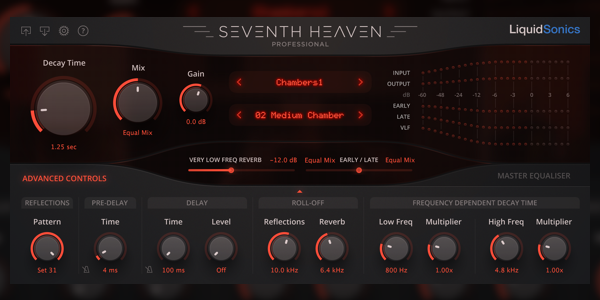
We provide sets of Fusion-IR expansion packs for LiquidSonics Reverberate 3 and Slate Digital VerbSuite Classics. The Fusion-IRs within Seventh Heaven and Seventh Heaven Professional further develop the concept by incorporating multiple variants of a preset so that many more dimensions of a reverb device can be reproduced.
It’s all in the modulation
Since an impulse response can only provide a single-shot capture of a reverb, most of the benefit of the modulation is lost. Attempts to capture modulated reverbs have in the past led to lifeless reproductions that reproduce many recognisable qualities of the original but lack their true character and do not blend organically with source material. They couldn’t fool anybody that has used the original. For years, convolution reverb has garnered a poor reputation as a result.
The perfect visual analogy of the problem is that of a photographer trying to capture the motion of cars on a highway at night. It is possible to use a long exposure blurring vehicles into a long streak of light along their path, smearing the detail but capturing an effect of the motion. This effect is what happens when one tone-sweeps a reverb; all the modulation is blurred into a single capture with impoverished definition. Alternatively, a very fast exposure captures all the details of the highway at a single moment in time, but it cannot convey any sense of the motion so much is lost in translation.
Naturally, the solution is to take multiple photographs and replay them in sequence. Using a suite of proprietary multi-sampling impulse response capture and replay technologies, LiquidSonics Fusion-IR follows the same approach for convolution as the early pioneers in motion picture.