
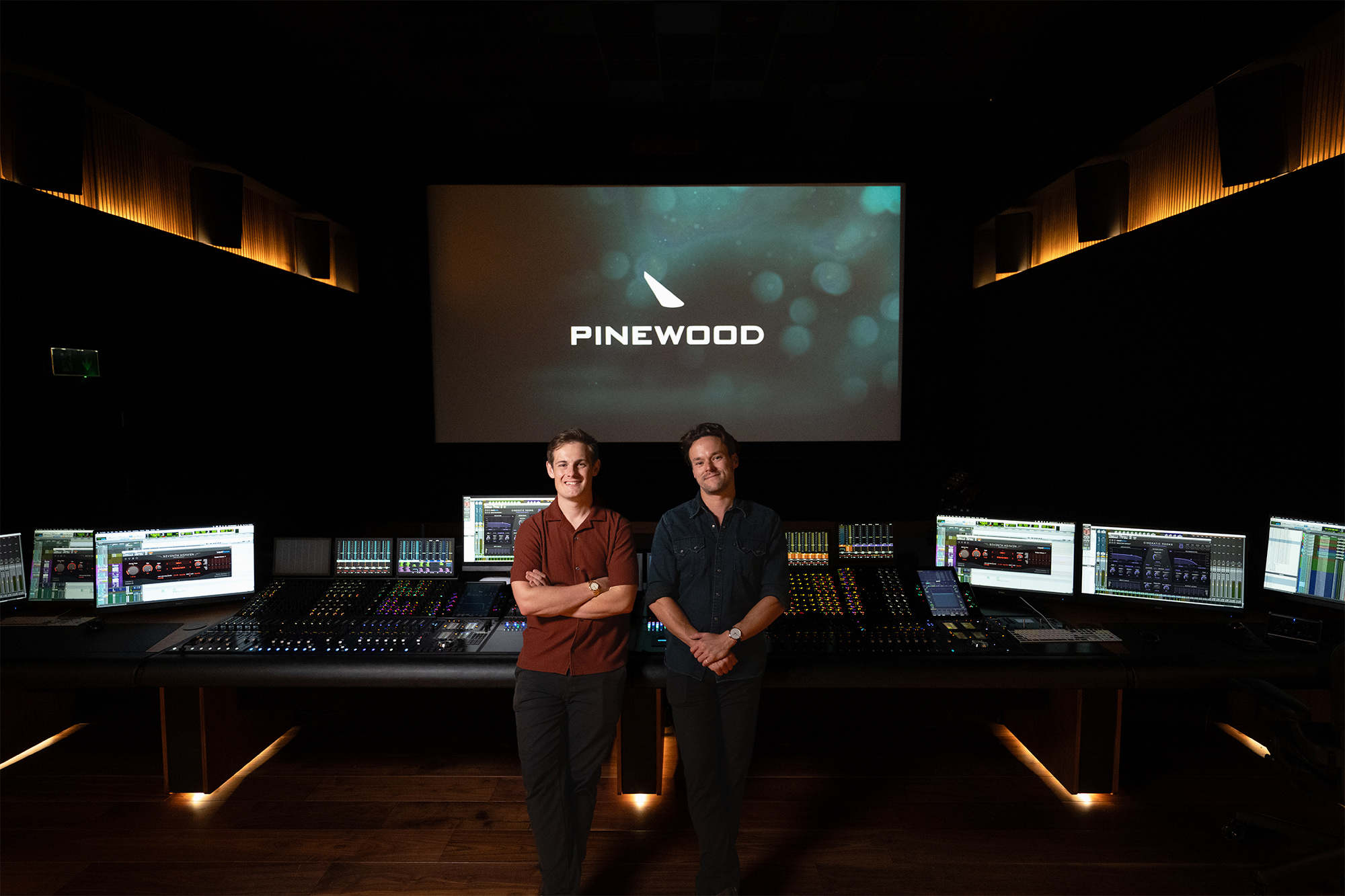
LiquidSonics recently visited Pinewood Post Production’s newly refurbished Pressburger Theatre, sitting down with re-recording mixer Jasper Thorn and senior mix technician Fergus Pateman to learn more about how reverb is used in modern film and TV post production environments.
In this article, we share some of the key takeaways from that conversation: the attention to detail necessary when designing a world class space like the Pressburger Theatre, the expectations of the clients who bring high profile projects to such spaces, and, of course, the reliance audio professionals have on trusted tools in such a fast-moving environment, including LiquidSonics reverbs such as Cinematic Rooms Professional and Seventh Heaven Professional.
Watch the full video below for the in-depth conversation with Jasper and Fergus.
Pinewood Post Production in a Diverse and Evolving Market
Pinewood Post Production, situated in picturesque Buckinghamshire to the west of London, England, offers state-of-the-art post production facilities for film and TV with services including audio mixing, international localisation and ADR from their purpose-built theatrical mix stages. Celebrating 90 years in 2026, it has hosted global blockbuster projects ranging from Ridley Scott’s Blade Runner, to James Bond: Live and Let Die, and many more.
The recently renovated Pressburger Theatre is Pinewood Post Production’s flagship mixing environment. Driven by a 47-speaker immersive monitoring system using custom JBL loudspeakers, it is capable of Dolby Atmos and multiple IMAX formats (including a dedicated “Voice of God” channel for IMAX 12). Beyond numerous blockbuster Hollywood films, the theatre has recently been used for a range of high-end TV projects, including Amazon MGM’s The Lord of the Rings – Rings of Power, live theatre and concert mixes.
Under the surface, the backend infrastructure has been standardised across all seventeen theatres’ facilities. Identical core configurations mean mixes can move between rooms quickly, which is not necessarily straightforward when projects have such diversity and range.
Jasper recalls, “One of the mixes I did went to five different theatres that we have. Five! Each and every time it’s simple enough to recall, and it’s fast.”
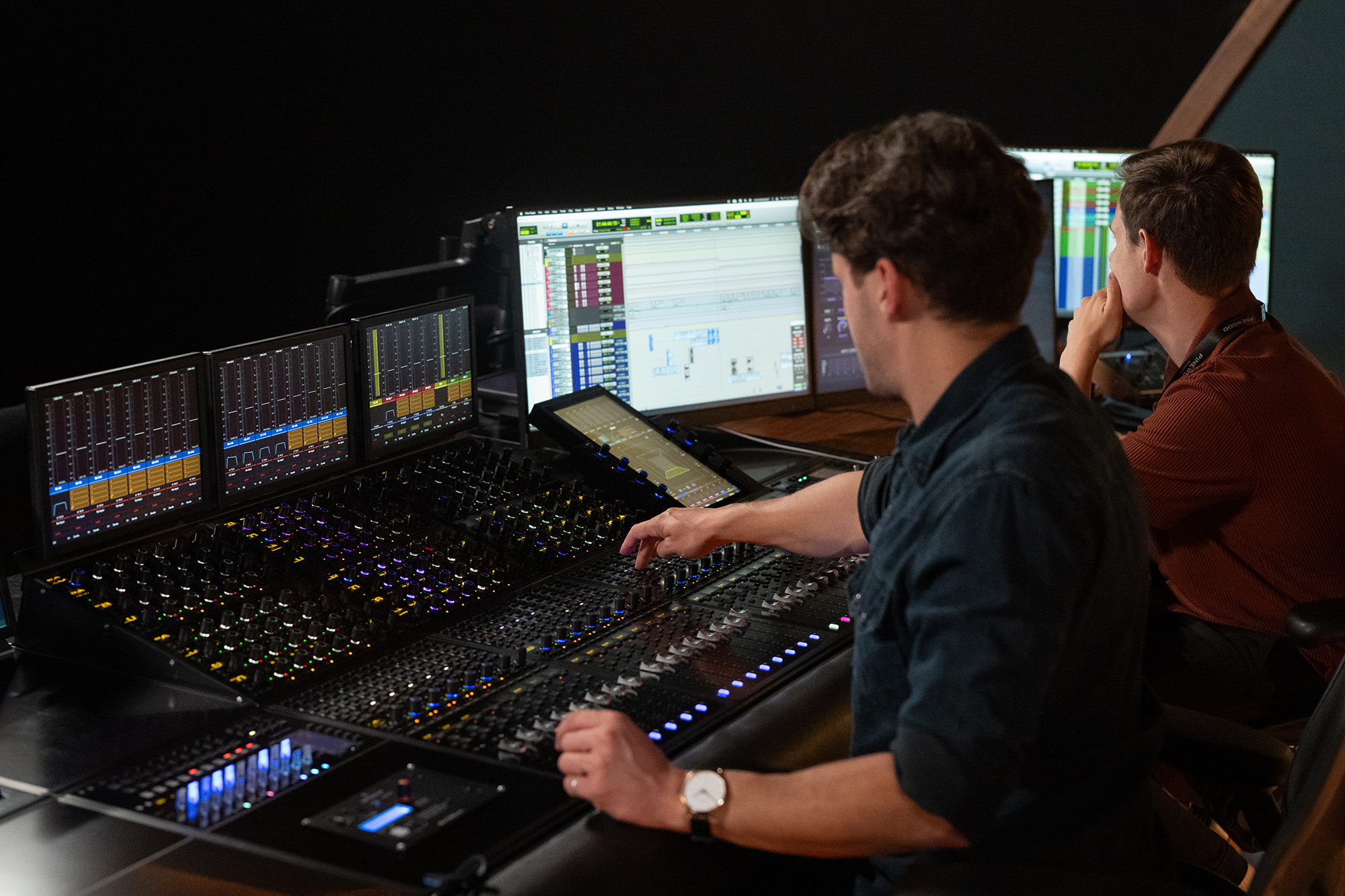
Six Apple Silicon Mac Pros, additional edit stations, dual Avid S6 consoles, Dante-enabled routing, BLU Link monitoring paths and Crown amplification are all part of a well-specified engineering ecosystem. The S6 modules are mounted in flexible buckets, allowing independent adjustment of the tilt of the surface’s displays and modules; screens are on adjustable Ergotron arms; lighting is zone-controlled. The capabilities of the room and its capacity to adapt with ease to a wide range of engineering requirements and client preferences are truly impressive.
Reverb for Modern Post Production
Across effects, dialogue and music workflows, LiquidSonics plugins have secured a place among a relatively small group of trusted third-party tools that are used daily by in-house staff and which are regularly found in the templates of engineers visiting the studio. In terms of reverb, such is the importance of this effect in post production, the team has heavily invested in a comprehensive suite of native reverb solutions from a range of manufacturers that also includes widely used plug-ins from Audio Ease and Exponential Audio (now owned by iZotope).
With such a comprehensive range of reverb options at hand, we were keen to explore how Pinewood Post Production’s in-house engineers choose between convolution and algorithmic reverbs. Fergus explains: “For trying to emulate the room that the sound was recorded in, people often will go towards a convolution reverb. On foley, it tends to be a convolution reverb trying to recreate a natural space.”
Convolution reverbs are often chosen when the task requires the reproduction of a specific space from the real world. Matching production dialogue, bedding foley into a recognisable acoustic, or reproducing the character of a real location via impulse responses sampled from the physical world is a task ideally suited to convolution. Often in post production, impulse responses are even available from on-set locations, or may be selected from a set of familiar IRs where Altiverb remains a firm favourite.
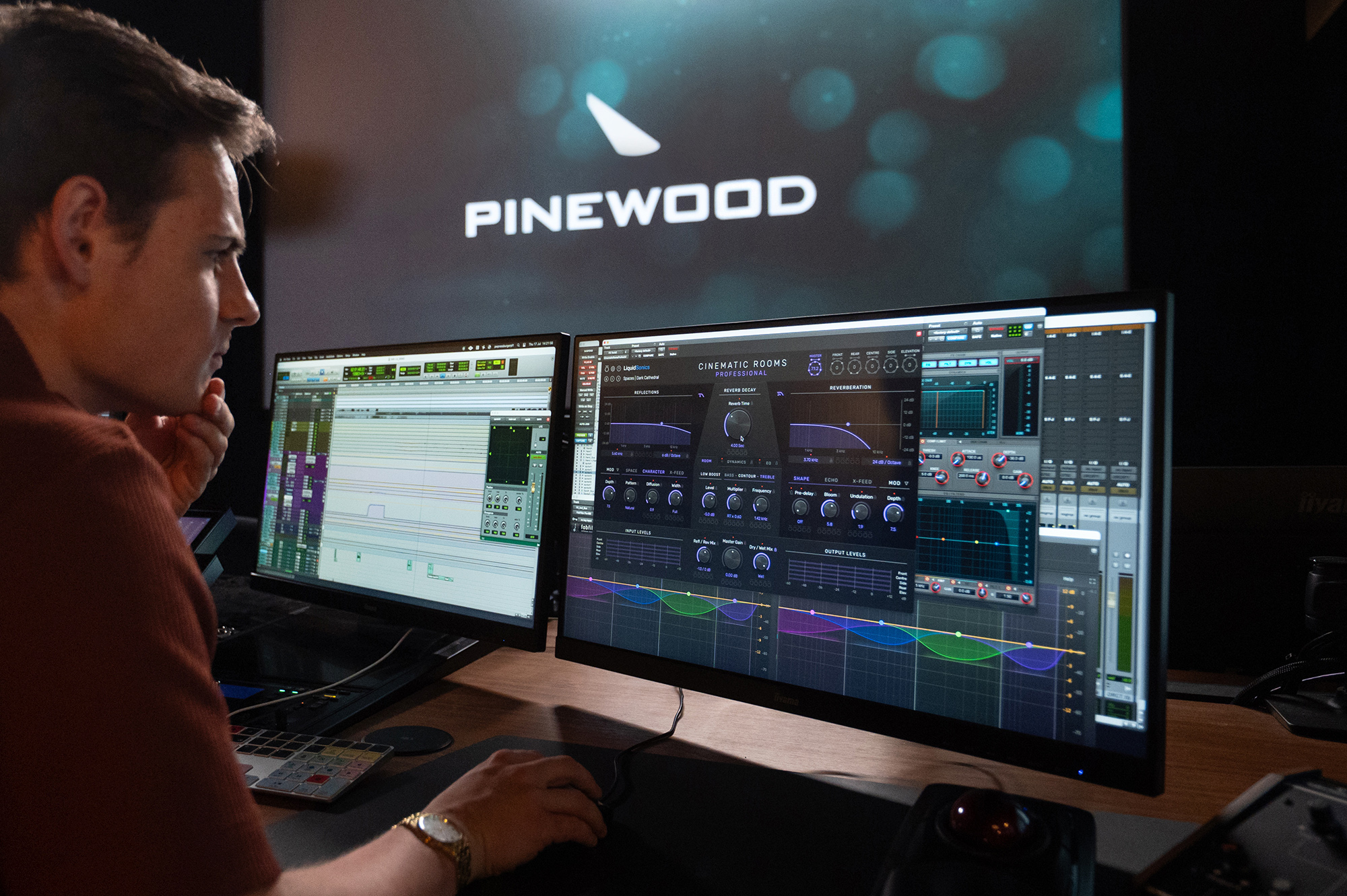
As the conversation turned to their algorithmic options, one of the principal strengths of algorithmic reverbs was seen as their flexibility and ability to accommodate rapid workflows in immersive as Jasper explained; “I think what people value with something like Cinematic Rooms is how tweakable it is.”
This control is important in immersive formats where small changes in early reflections, decay shaping, or modulation can materially affect spatial perception and the musicality of the space. An algorithmic design is uniquely positioned to provide fine-grained control over all aspects of an environment. Importantly, this isn’t confined to any particular genre or mixing requirement. Jasper is clear that those longer reverbs are often very effective on dialogue and effects when a larger-than-life sense of space is needed, particularly in theatrical contexts where emotional scale may exceed literal reality.
“What I love about Cinematic Rooms is the lushness, the beautiful musical sounding tails,” adds Jasper. “You don’t have to cycle through five or six presets – straight away, there’s going to be something that works.”
Fergus goes deeper, explaining that he loves the controllability provided by Cinematic Rooms Professional’s surround editing planes where every parameter can be adjusted to meet the requirements of mixing for regions in the room all within a single plugin instance.
“I love the fact that all the parameters scale as a percentage of the master, and you can really easily link them back to the master. I think that’s really cool. Let’s say you want the reverb to linger in the top of the room – you can go in, a couple of button presses, and you’ve achieved that effect.”
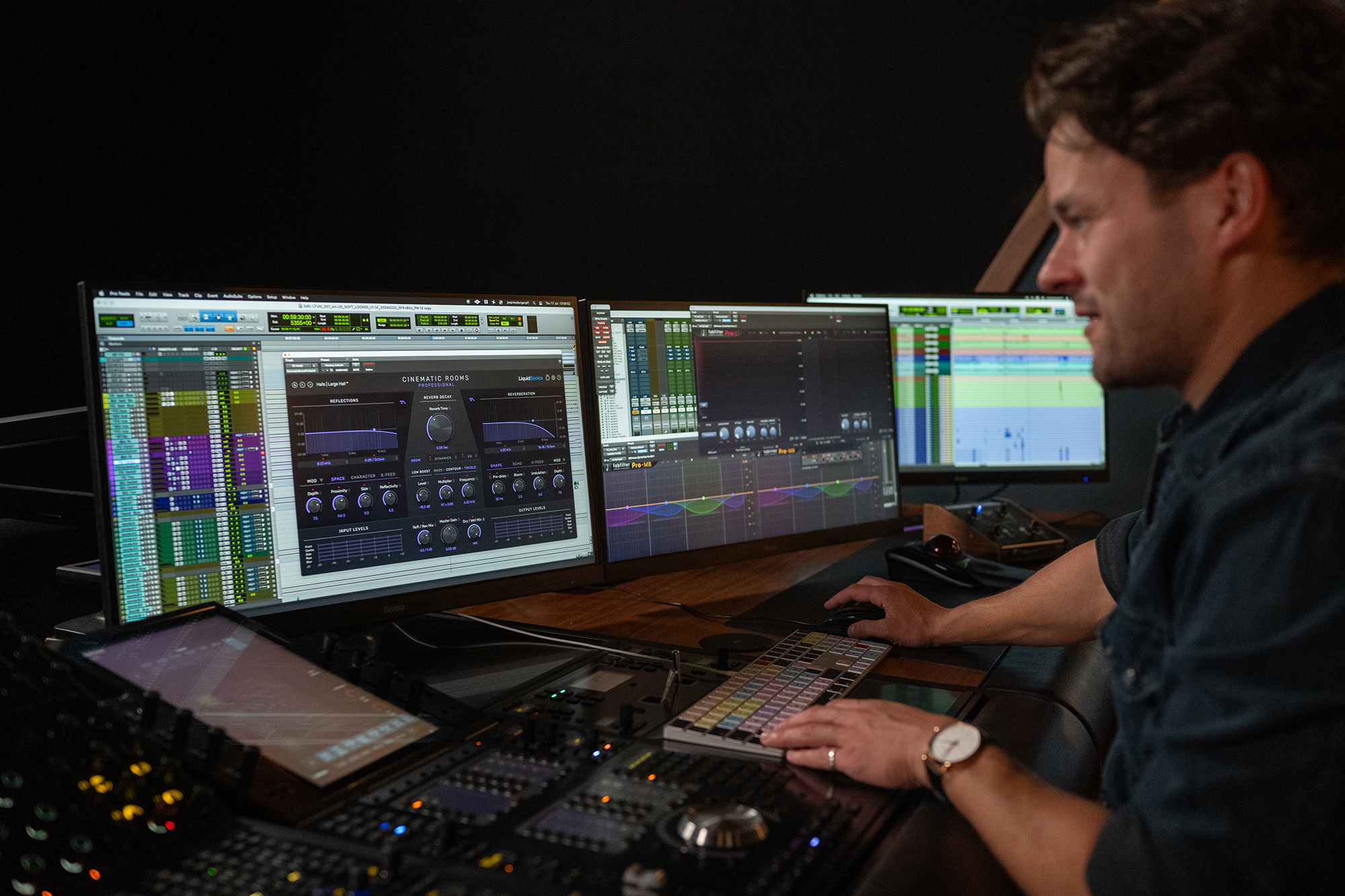
Pinewood Post Production has selected a wide range of tools that complement one another perfectly, as illustrated during a discussion about the recent project Next To Normal; a live-filmed stage production in which Cinematic Rooms Professional and Seventh Heaven Professional were both used to create distinct acoustic aesthetics.
Cinematic Rooms Professional was found to be ideal for the ambiences needed during environmental enhancement, the sense of being in the theatre, reinforcing the physical space and creating a credible but satisfyingly larger-than-life feeling. “Cinematic Rooms was the sound of the theatre, to really sell the space. Seventh Heaven was used as the sort of musical reverb”, Fergus explained, which provides access to all of the well-known Bricasti M7 presets that have become essential to so many workflows, but with the added capability of surround, giving a distinctive musical character to drum, piano and vocal reverbs when mixing in immersive.
In transitions between spoken drama and song, the mixers blended the two approaches. Cinematic Rooms Professional remained subtly present to anchor the space, while Seventh Heaven Professional could take prominence during musical passages, delivering a familiar, musically flattering reverb identity.
Giving each reverb a defined role produced clarity. Spatial coherence on one side, musical sheen on the other. It is a great example of complementary tools operating within a single immersive mix.
Learn more about how to create compelling immersive reverbs in Cinematic Rooms Professional in the short video below:
The Importance of Reverb Presets for Post Production
Whenever we speak with professionals working under tight deadlines, as is often the case in post production, the importance of a strong presets library is often emphasised. A well-curated preset collection reduces decision friction, essential in a fast-moving session. It provides a reliable starting point that often requires only minimal adjustment – that’s why we worked with some of the industry’s leading post production and score mixers including Alvin Wee and Simon Franglen to develop presets that professionals can rely on at every stage of the production process.
When working with Cinematic Rooms Professional’s factory presets, Jasper noted: “You can pull it up, almost every time you’re impressed with what it’s doing.” Within Cinematic Rooms Professional, certain presets, including perennial favourites such as its default preset Amethyst Hall, have developed reputations as dependable first calls which are often all the sound needs. That reliability becomes especially valuable under time pressure. A mixer can instantiate a known algorithmic preset and refine from there.
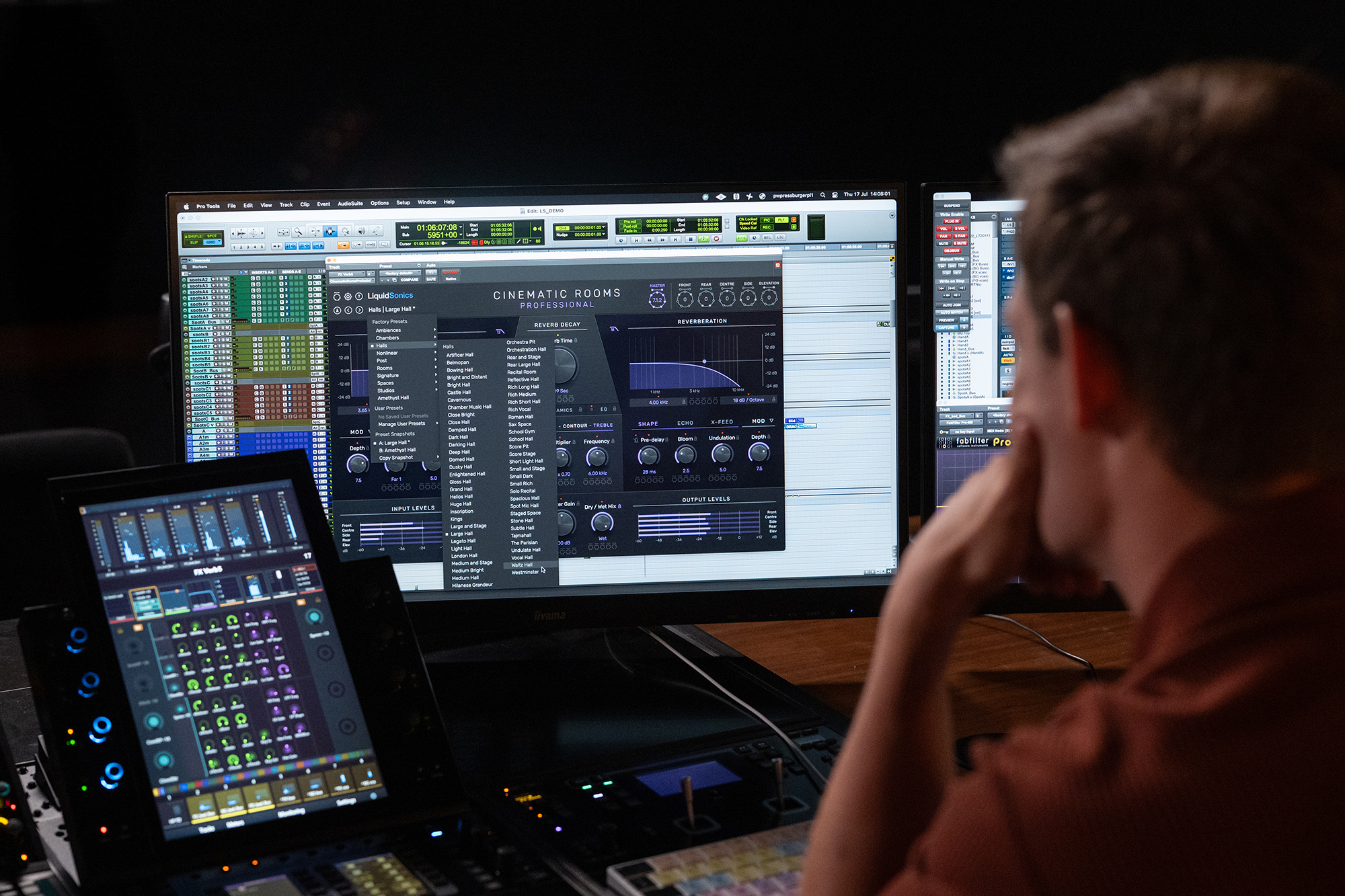
In a multi-theatre facility where mixes may travel between rooms over the course of a project, that combination of speed and consistency is essential. Being able to recall sessions with minimal friction is aided through the use of plugin reverbs, console automation issues being bypassed through the use of the Avid S6 and crucially, common equipment between the theatres.
In large-scale post, speed and efficiency are essential. Recall of projects with native reverb within Pro Tools and the Avid S6 ecosystem allows mixers to move rapidly between projects and theatres in a way that was just not possible in the past. When projects need to move between rooms, producers and executives expect seamless playback and recall; “we need instant recallability between the different reels of a film,” noted Jasper. Software reverbs inherently support these requirements, with at most the movement of a handful of software licenses between systems which is the work of a moment in a fully networked computing system.
The Final Playback
After weeks or months of work, with reels stitched together, balances refined and automation written and rewritten, producers, creatives and stakeholders take their seats for the final playback. There is a brief moment of apprehension.
“You hit play and after about five minutes you relax into it,” Jasper reflects.
A strength of a room like the Pressburger Theatre, and the carefully chosen tools within it, is that it enables rapid mix decisions that allow the audio to support the picture in the way the director demands while translating to a wide range of home and theatre playback environments. The technology chosen by Pinewood’s post production engineers serves this goal with the utmost attention to detail and precision.
Acknowledgments
Reflecting on the environment, Jasper mentioned “You feel very fortunate getting to spend time in this place”. After our interview the team generously set aside time for us to enjoy some pieces mixed in the room and we certainly agree that it is indeed a wonderful room for anybody with a passion for high fidelity immersive audio.
LiquidSonics is immensely proud to be able to supply reverb products to the team at Pinewood Post Production that meet the workflow and acoustic requirements found when working at the highest level in our industry.
Thanks to Jasper Thorn and Fergus Pateman for their time and insight, and to the wider Pinewood Post Production engineering staff that supported our visit, from the runners up, for their contribution to an environment that continues to set the highest bar for immersive post-production.
