
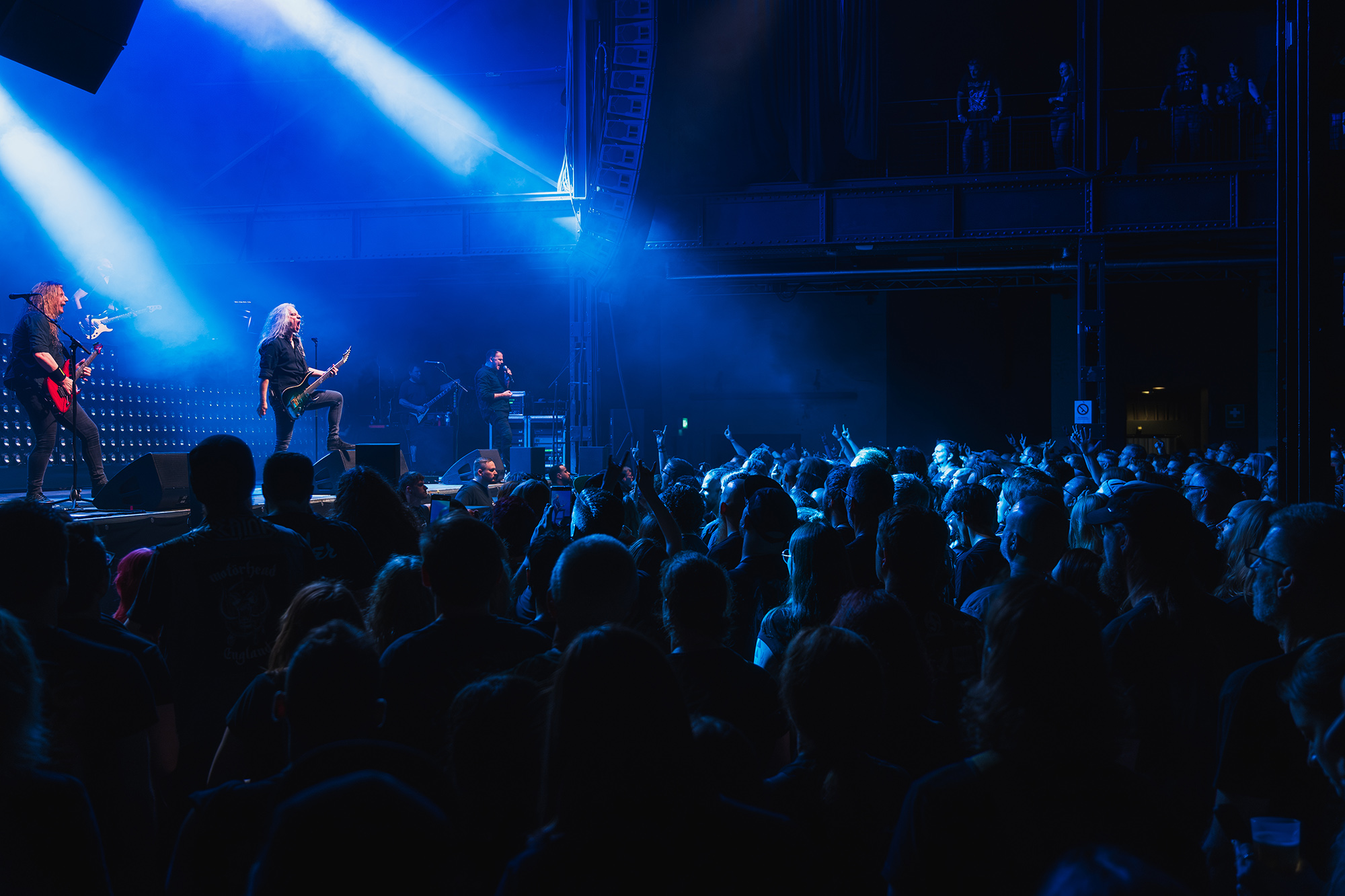
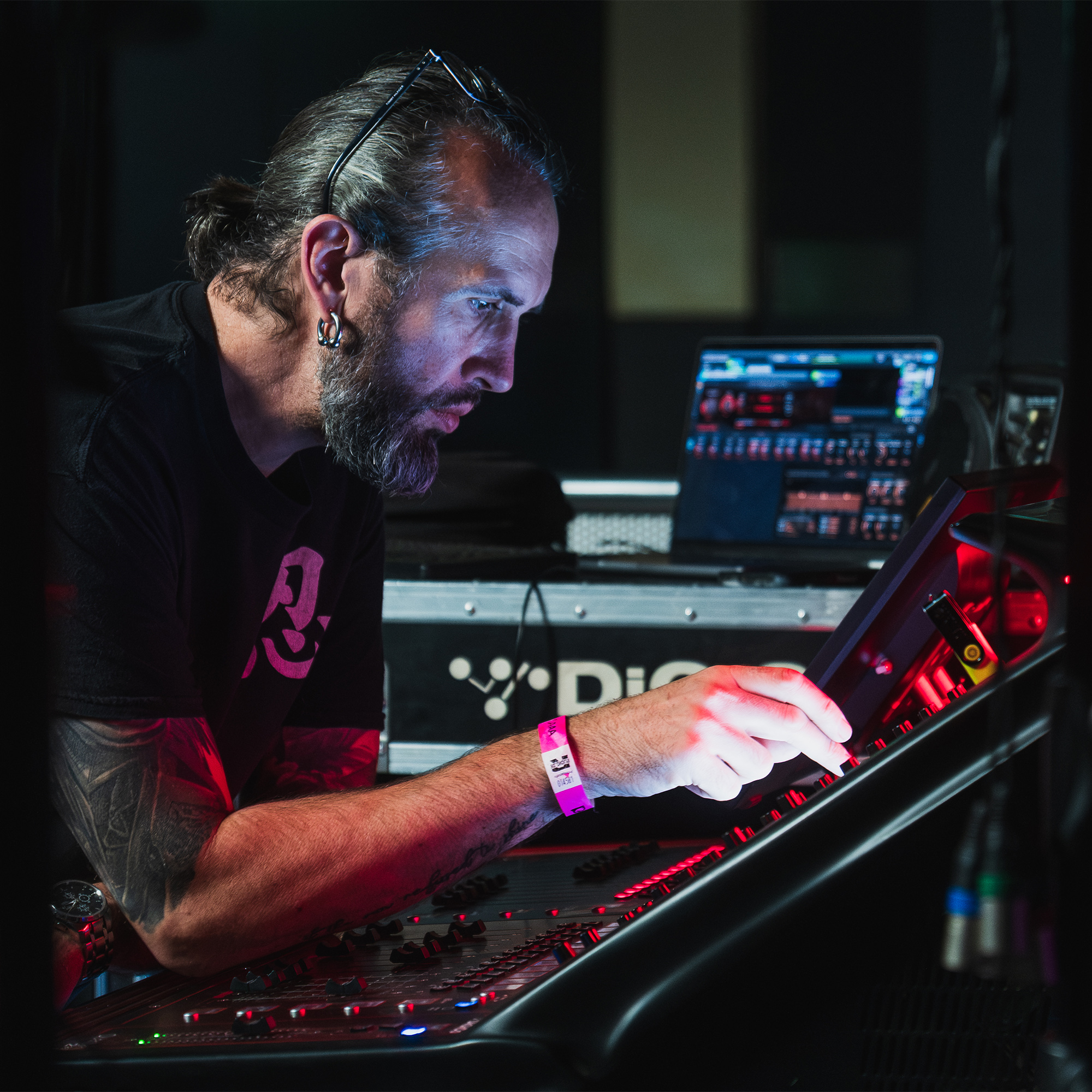
In the summer of 2025, power metal icons Blind Guardian wrapped their tour with a show at the Palladium in Cologne, Germany. For front-of-house engineer James Dunkley, this full-production event represented the culmination of an approach he’d been refining throughout his career: what he terms “high fidelity heavy metal.”
James’ philosophy centres on delivering clarity and focused power when mixing high-tempo metal music, and he leans heavily into reverbs that recreate the presence of real venues for convincing depth and dimension in live shows.
We had the chance to experience one of Germany’s most beloved metal bands firsthand and speak with James about his live sound mixing approach and the tools behind it. We explore the challenge of maintaining clarity at 200 BPM, and how he uses Tai Chi and Seventh Heaven Professional in LiveProfessor alongside his outboard effects rack for studio-quality reverb on the road.
The Challenge: Clarity at 200 BPM
Blind Guardian‘s music presents a mixing challenge that will resonate with any metal music engineer: “When you’ve got something going at about 200 BPM with kick drums playing 32nds; snares all hell for leather; cymbals everywhere; and then layers of keys, two guitars, a bass, backing vocals and the lead vocal – there’s a lot going on,” James explains.
A defining trait of power metal is its dense layering of musical elements, where every instrument competes for space in the frequency spectrum. The complex arrangements and busy performances leave little latitude to find room in time and frequency for everything the musicians are delivering, demanding precision at every stage of the signal chain.
For James, the job is to make sure that every little detail of the band’s performance translates. “If it’s not clear and you can’t hear it, then why is that guy bothering to play it?” he asks. It’s a simple question with profound implications for his mixing philosophy. Every part deserves its moment, which means every tool in his signal chain needs to earn its place by supporting his pursuit of mix clarity.
This is especially true for Blind Guardian’s vocalist Hansi Kürsch, whose powerful delivery is central to the band’s identity. “With a band that is known for having a strong vocalist, you’ve got to hear him at all times,” James notes. “He’s got to be clear and present, but not at the expense of everybody else.”
A High Fidelity Philosophy
James’ approach deliberately borrows from worlds beyond metal. “I’m aiming for the sort of top-end stuff that you find in pop, or even theatre, or maybe even film,” he explains. “I’m trying to have a bit more of a high fidelity approach to heavy metal.”
This philosophy extends to every equipment choice, but nowhere is it more critical than in his reverb selection. “It’s really easy to cloud and crowd the audio spectrum with the wrong reverb,” he points out. James chooses reverbs that fit naturally into the mix without turning the performance into what he calls “a cartoon.”
Live consoles often have a range of convenient built-in reverb options, and budget-friendly outboard reverb is often a necessity when mixing on the road, but James takes a different path:
“I’m trying as much as I can to use high-end gear, the type of which you don’t see so much in underground metal,” he says. “I’m trying to attain that sort of quality and clarity through my equipment choices.”
James’ workflow builds on a traditional DiGiCo console and outboard processors, which he enhances with native effects running on a laptop in Audioström’s LiveProfessor. This gives him access to a broader palette of effects and additional processing power, while maintaining the traditional mixing benefits of his core live setup.
He’s part of a growing trend of live engineers expanding their options with specialist plugin hosts that simplify the process of bringing studio-grade plug-in processing to live events. We are increasingly seeing engineers like Tom Marshall or Stephen Hughes deploying <span”>Fourier Audio’s transform.engine<span”> in broadcast and FOH applications, and we recently heard from Toto’s front-of-house Ken Freeman who uses a sophisticated <span”>Apple MainStage rig with up to 12 instances of Seventh Heaven Professional providing myriad reverb options – for more details unfold the panel below.
LiquidSonics in Action: Tai Chi and Seventh Heaven Professional
Two LiquidSonics plugins form the core of James’ reverb strategy for Blind Guardian: Tai Chi for vocals and Seventh Heaven Professional for snare.
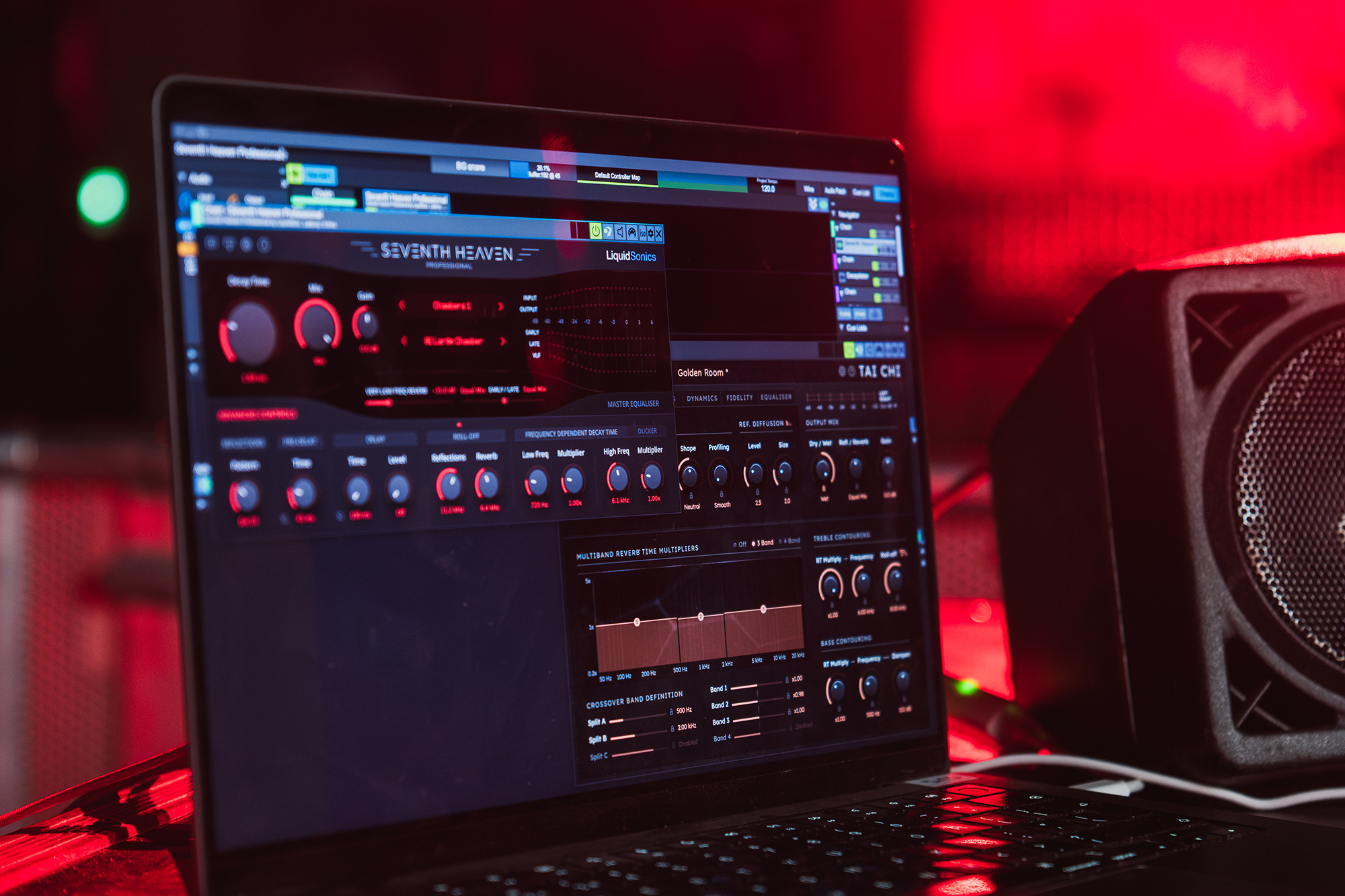 For Hansi Kürsch’s vocals, James relies on Tai Chi’s Golden Room preset as his starting point. “I settled on the Golden Room and then adjusted from there: mainly pre-delay and reverb time,” he explains, “then a bit of EQ on the return, just dialling it in so it suits the vocal. It doesn’t seem separate from the vocal and just gives him a sense of space.”
The result passes James’ ultimate test for vocal reverb: “That one’s winning because it’s really natural sounding,” he says. “You don’t listen to it and think, ‘oh, there’s a reverb on that voice.’ You’re listening to that voice in the room.”
For snare, Seventh Heaven Professional delivers what James needs with minimal adjustment. “I’m using Seventh Heaven as my main snare reverb. I played a little bit with the pre-delay and the reverb time, but generally it’s doing what I need straight out of the box.”
What unites both choices is the quality James values most: authenticity. “The area I find LiquidSonics really useful is that it does sound like real spaces rather than an artificial, forced, plastic reverb,” he explains. “The type you might find on a few other desks or pieces of outboard. It sounds like a real space. It’s a natural-sounding algorithm.”
In the context of dense, fast metal, natural-sounding algorithms add dimension without compounding the clarity challenges that already define live mixing.
Inside the Effects Rack
James’ effects architecture reveals an engineer who values both precision and creative flexibility. His setup includes 13 effect returns, each serving a specific purpose but all available for spontaneous decisions during the show.
“The idea is I’ve got things that I can throw in and pull out as I feel the need,” he explains. The system runs on snapshot automation, with tempo locked to each song. Reverb times, decay settings, and delay times all shift automatically as the setlist progresses.
James uses this setup to expand the potential for creative expression during live events, maintaining multiple options for key elements that allow him to make instinctive judgement calls quickly: “I’ve got two snare reverbs I can just flick between, depending on my mood. There’s nothing more scientific about it than that.”
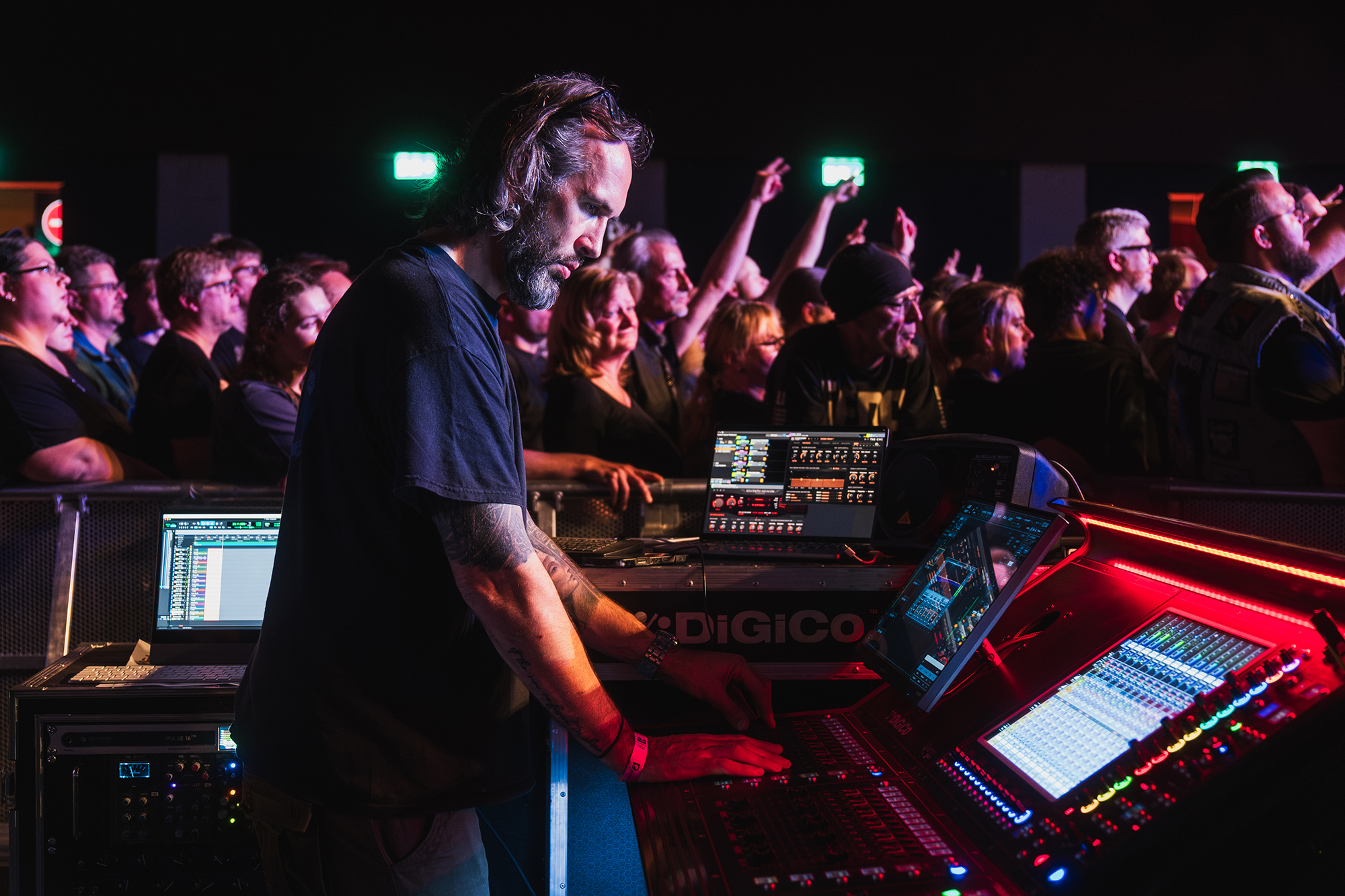 The vocal mix is supported with a similarly flexible technique, with James running three distinct reverb options, all completely different in character. “It literally depends on what I feel like throwing in on the day,” he says. At the Cologne show, Tai Chi’s Golden Room was the choice. Its natural-sounding algorithm placed Hansi’s voice in the space without ever announcing itself as an effect, exactly what James needed to maintain clarity through Blind Guardian’s densest passages.
Seventh Heaven Professional serves as one of his snare reverb options, giving him the flexibility to choose between different characters depending on the song’s demands or simply his instinct in the moment. This approach of having multiple high-quality options rather than a single “correct” choice reflects James’ broader philosophy of treating live sound as a creative endeavour rather than a technical one.
The master-send structure allows him to route signals to multiple reverbs simultaneously when desired, creating layered spatial effects that would be impossible with a simpler setup. Combined with alternate input routing on his digital console, James can swap entire effect chains without disrupting his fader workflow.
Convincing Spaces for Real Performances
James Dunkley’s work with Blind Guardian demonstrates what becomes possible when live sound engineers reach beyond traditional live workflows. His high-fidelity philosophy, applying the standards of studio production, theatre, and film to touring metal, requires tools that can deliver authenticity under demanding conditions while staying within sometimes tight live sound budgets.
“It’s the flexibility,” he concludes, reflecting on why LiquidSonics plugins have earned their place in his rig. “That, and the fact that they are high-end and super clear.”
For engineers mixing dense, heavy music in live sound applications, James’ approach offers a compelling template: choose reverbs that sound like real spaces, build systems that allow creative flexibility, and let the pursuit of clarity guide every decision.
Huge thanks to James Dunkley for allowing us an inside look at his mixing philosophy. Also, thanks to Blind Guardian, Thomas Geiger, and the staff at the Cologne Palladium for hosting our team during the video shoot.

Blind Guardian
Blind Guardian are a German power metal band founded in 1985, known for their dense, layered arrangements that draw heavily on fantasy literature and mythology. Built around vocalist Hansi Kürsch’s energetic delivery and André Olbrich’s intricate guitar work, the band has earned a devoted global following across more than four decades.
